To present data for plasma electrolytes and urine output of water and electrolytes in humans under normal control conditions (control - no water-loading).
Objectives:
On completion of this section of the program you should be able to:
describe plasma electrolyte concentrations and urine output of water and electrolytes under normal physiological conditions
suggest how the nephron modifies tubular urine to maintain fluid homeostasis
calculate the glomerular filtration rate
calculate the fractional reabsorption of water and electrolytes
Protocol
Results
Plasma
Urine
Control Experiment Quiz
Question 1 of 13 on Control Experiment
In the control experiment human subjects are asked to drink 90 ml of water every hour. Why do you think this is?
True
False
To quench thirst
To increase urine flow
To replace normal urinary water losses
To change plasma osmolality
To change ADH release
If you look at the data for the experiment you will see that urine flow is approximately 1.5 ml/min or 90 ml/h. Subjects drink this volume each hour to replace urine water losses. It is insufficient to quench thirst, to stimulate urine flow (diuresis), or change plasma osmolality and ADH secretion.
Question 2 of 13 on Control Experiment
Clearance is a term used frequently to describe how the kidney handles different substances. Think about what this term might mean and then select one definition from the list below:
True
False
the elimination of waste products from the body by the kidneys
the quantity of a substance excreted by the kidneys
the volume of plasma from which a substance is completely removed per minute by excretion
the volume of urine excreted per minute
Clearance or more correctly renal plasma clearance is the volume of plasma cleared of a substance by the kidneys each minute. The units are ml per minute.
Question 3 of 13 on Control Experiment
The renal processes involved in clearing substances from plasma are shown below:
Consider the following scenario and choose the answer you think best fits:
If a substance is filtered but is neither reabsorbed nor secreted, the clearance will be:
True
False
125 ml/min
0 ml/min
1.25 ml/min
If the substance is neither reabsorbed nor secreted its clearance will be equal to the rate of filtration at the glomerulus - the glomerular filtration rate (GFR).
Question 4 of 13 on Control Experiment
The renal processes involved in clearing substances from plasma are shown below:
Consider the following scenario and choose the answer you think best fits:
If a substance is filtered, 99% reabsorbed but not secreted, the clearance will be:
True
False
125 ml/min
1.25 ml/min
123.75 ml/min
If the substance is 99% reabsorbed then only 1% is excreted i.e. 1.25 ml of plasma is cleared of that substance per minute. This would be a typical clearance value for Na+.
Question 5 of 13 on Control Experiment
The renal processes involved in clearing substances from plasma are shown below:
Consider the following scenario and choose the answer you think best fits:
If a substance is filtered, 60% reabsorbed but not secreted, the clearance will be:
True
False
50 ml/min
125 ml/min
75 ml/min
If the substance is 60% reabsorbed then 40% is excreted i.e. 50 ml of plasma is cleared of that substance per minute. This would be a typical value for urea which despite being a waste product is 40-60% reabsorbed by the kidneys.
Question 6 of 13 on Control Experiment
The glomerular filtration rate is a clinically useful measure of kidney function. We can obtain a measure of the GFR by calculating the clearance of a suitable substance from plasma. Think about what properties such a substance would have to be suitable and answer the following true or false.
The substance must:
True
False
be filtered
be measurable
be fully reabsorbed
not be reabsorbed
be secreted
To be suitable the substance must be freely filtered from plasma and neither reabsorbed nor secreted. We must also be able to measure its concentration in plasma and urine.
Question 7 of 13 on Control Experiment
Do you know which of the following substances might be suitable to calculate GFR. Answer the following true or false.
True
False
urea
inulin
albumin
glucose
creatinine
Inulin is the most suitable substance as it is freely filtered and is neither reabsorbed nor secreted. Albumin is a plasma protein which is too large to be normally filtered. Glucose is fully, and urea partially reabsorbed. Creatinine fulfils most of the criteria except that a small amount (10%) is bound to plasma proteins and it is secreted. However, since it is found in humans, creatinine clearance is used clinically as an index of GFR and to assess kidney function.
Question 8 of 13 on Control Experiment
GFR is calculated by measuring the plasma concentration and urine output of a substance which is filtered but neither reabsorbed nor secreted. One such substance is inulin.
Inulin is a polymer of the monosaccharide fructose. It is not found in humans but is produced by certain plants. When it is injected into the blood, it is freely filtered by the glomeruli and is neither reabsorbed nor secreted.
The values are given below:
[inulin] plasma = 0.5 mg/ml (P)
[inulin] urine = 30 mg/ml (U)
urine flow = 2 ml/min (V)
Use these values to calculate GFR. Choose the answer which you think is correct.
True
False
60 ml/min
120 ml/min
30 ml/min
The clearance if inulin is equivalent to GFR. Since the urine output of inulin is 60 mg/min (U x V) then you would need to filter 120 ml of plasma per minute (containing 0.5 mg/ml of inulin) to excrete this amount.
Since inulin is neither reabsorbed nor excreted then the amount inulin filtered = the amount of inulin excreted:
GFR (ml/min) x P (mg/ml) = V (ml/min) x U (mg/ml)
Thus GFR = (V x U) / P
Question 9 of 13 on Control Experiment
You have now seen the plasma and urine data for water and solutes in the control experiment. There are several calculations you can perform which will give useful information about kidney function.
Calculate GFR (use creatinine values in the period 180-240 min). Type in your calculated value (to one decimal place).
Creatinine is produced as a waste product of muscle creatinine. It is filtered, not reabsorbed but small amounts are secreted by the renal tubules. Its clearance is used clinically as an indicator of renal function. Since it is secreted its clearance will be fractionally higher than GFR.
Answer:
Sorry, GFR is calculated from the following equation:
GFR(ml/min) = Urine output of creatinine(µmole/min) / plasma creatinine(µmole/ml)
GFR is calculated from the following equation:
GFR(ml/min) = Urine output of creatinine(µmole/min) / plasma creatinine(µmole/ml)
= 11.3 / 0.086
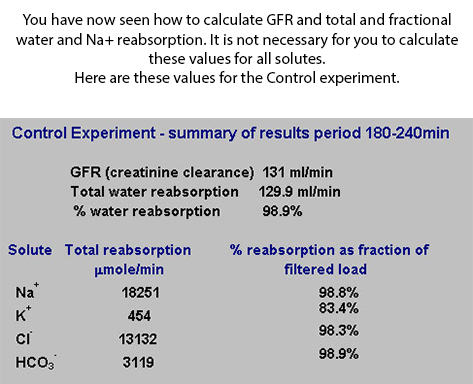
= 131.4 ml/min
Question 10 of 13 on Control Experiment
Calculate the total water reabsorption in the period 180-240 min (to one decimal place).
Answer:
Sorry, the total water reabsorption is calculated by subtracting the urine flow output from the GFR.
The total water reabsorption is calculated by subtracting the urine flow output (V = 1.5 ml/min) from the GFR (131.4 ml/min when calculated from the data).
= 131.4 - 1.5
= 129.9
Question 11 of 13 on Control Experiment
Calculate the % water reabsorption (i.e. total reabsorption expressed as a % of GFR) (to one decimal place).
Answer:
Sorry, the % water reabsorption is calculated from:
(GFR - V) / GFR
The % water reabsorption is calculated from:
(GFR - V) / GFR
= (129.9 / 131.4) x 100
= 98.9
Question 12 of 13 on Control Experiment
Calculate the total Na+ reabsorption (µmole/min) in the period 180-240 min (to the nearest whole number).
Answer:
Sorry, the total Na+ reabsorption is calculated by subtracting the urine Na+ output (µmole/min) from the total Na+ filtered (GFR x plasma Na+ µmole/min).
The total Na+ reabsorption is calculated by subtracting the urine Na+ output (220 µmole/min) from the total Na+ filtered (GFR x plasma Na+ = 131.4 x 141 = 18527 µmole/min).
= 18527 - 220
= 18307
Question 13 of 13 on Control Experiment
Calculate the % Na+ reabsorption (i.e. total reabsorption expressed as a % of Na+ filtered) (to one decimal place).
Answer:
Sorry, the % Na+ reabsorption is calculated from:
Na+ reabsorption / (GFR x plasma Na+)
The % Na+ reabsorption is calculated from:
Na+ reabsorption / (GFR x plasma Na+)
= (18307 / 18527) x 100
= 98.8%
Summary
You have now seen how to calculate GFR and total and fractional water and Na+ reabsorption. It is not necessary for you to calculate these values for all solutes.
 DEMO
DEMO